Best Boutique Hotels for Extended Stays: A Professional’s Guide
The convergence of global labor mobility and the revaluation of the “home office” has fundamentally altered the hospitality sector. Historically, the hospitality industry was divided into two distinct, non-overlapping streams: the transient, high-touch boutique hotel designed for the weekend getaway or the brief business trip, and the institutional, sterile residential hotel optimized for long-term corporate housing. These streams have now collided. Travelers are no longer content with the utilitarian, beige consistency of extended-stay corporate suites, yet they require the functional infrastructure that a standard boutique hotel—often designed for a 48-hour stay—frequently lacks.
This shift presents a nuanced architectural and operational challenge. A truly effective extended-stay property must reconcile the “boutique” imperative of distinct design, local immersion, and elevated service with the “residential” requirements of sustainable living: adequate storage, ergonomic workspaces, laundry facilities, and the intangible psychological necessity of feeling “settled” rather than “visiting.” To identify the top of this market, one must look beyond aesthetics and examine the operational scaffolding that supports multi-week or multi-month tenure.
This article provides a rigorous, data-driven framework for evaluating residential hospitality assets. It bypasses the surface-level marketing claims found in typical travel content to focus on the structural, economic, and logistical criteria that define genuine capability in this category. For the sophisticated traveler and the organizational planner, this is the definitive guide to navigating the complexities of long-term independent lodging.
Understanding “best boutique hotels for extended stays”
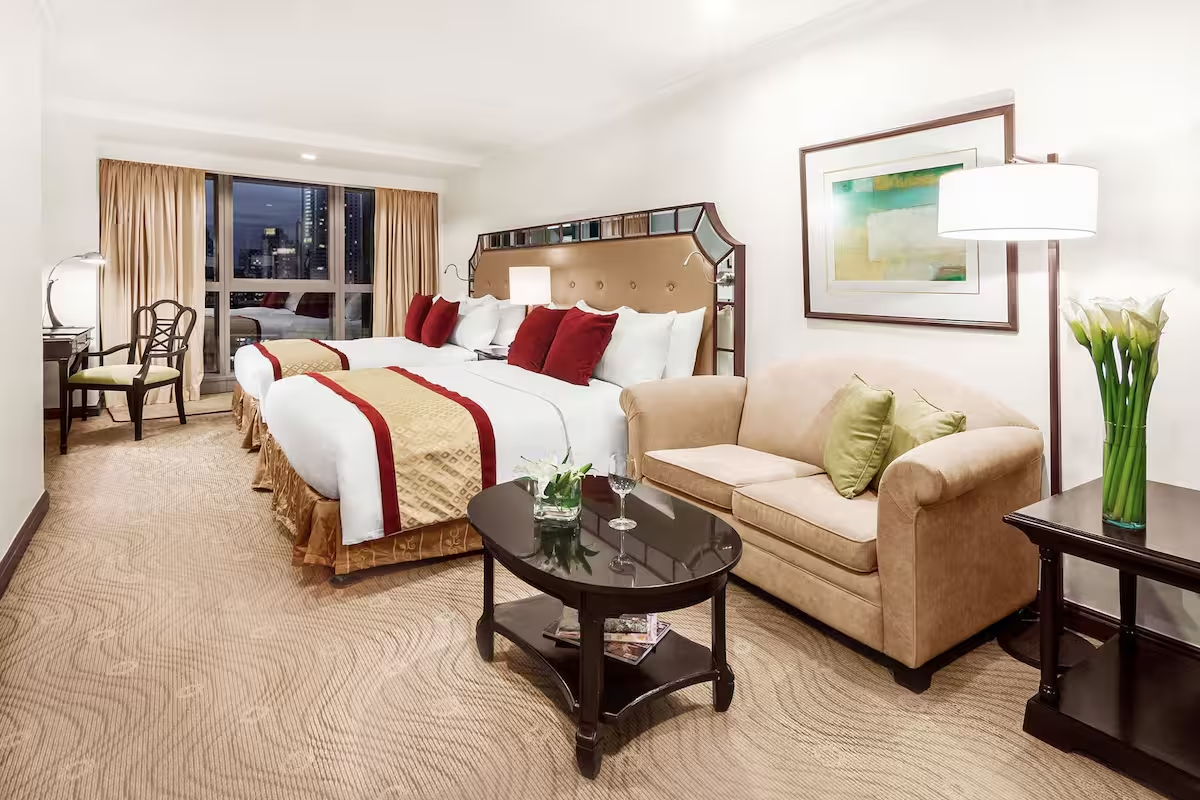
The pursuit of the best boutique hotels for extended stays is a exercise in filtering. The phrase is frequently misappropriated by marketing departments to describe standard rooms with a slightly larger closet or a desk that is technically a table. True extended-stay boutique properties are defined by “intent-based design”—architecture that assumes a long-term inhabitant. The confusion in the marketplace often stems from the conflation of “long-stay amenities” (like a kitchenette) with “long-stay livability” (which includes acoustic privacy, storage, and communal integration).
Oversimplification is the primary threat to the planner. A property might be visually stunning and located in a prime neighborhood, but if it lacks the robust back-end infrastructure required for a 30-day stay—such as high-speed, dedicated bandwidth, or on-demand laundry—the stay will inevitably devolve into a series of logistical frustrations. To truly understand the best boutique hotels for extended stays, one must adopt a multi-perspective view: evaluate the property not as a consumer of a “vacation,” but as an occupant of a “habitat.”
The danger in ignoring this distinction is the “Service Burnout” phenomenon. Short-term guests expect a hotel to cater to their every whim. Long-term guests, however, require autonomy. A hotel that insists on daily housekeeping and aggressive concierge intervention for a three-week stay actually erodes the value of that stay. The optimal properties are those that successfully navigate this delicate balance: providing the service of a hotel when requested, but the independence of an apartment when preferred.
Deep Contextual Background: The Evolution of the Residential Hotel
The residential hotel, or the “apartment hotel,” was a staple of urban living in the early 20th century. These properties functioned as permanent residences for professionals and intellectuals, combining the amenities of a hotel with the permanency of a lease. As the hospitality industry moved toward mass-market standardization in the 1970s and 1980s, the residential hotel was largely replaced by the sterile “extended stay” brand—a product defined by consistency, suburban locations, and low operational cost.
We are currently witnessing a return to the residential hotel concept, but with a modern, boutique inflection. This “third-wave residential” hospitality is characterized by adaptive reuse of historic structures, a deep integration with local neighborhoods, and a reliance on high-end, durable finishes rather than the disposable “fast-furniture” common in chain hotels. The evolution is marked by a shift from efficiency to experience. The market now demands properties that are as geographically and culturally specific as a boutique hotel, yet as operationally functional as a corporate apartment.
Conceptual Frameworks: The Livability-Vibe Equilibrium
To evaluate these properties effectively, one must employ mental models that weigh subjective atmosphere against objective function.
-
The Spatial-Temporal Flow: This model analyzes how a space functions over a 16-hour waking day. Does the room transition seamlessly from a workspace to a dining area to a leisure space? If the furniture configuration is static and inflexible, the space will feel increasingly cramped over time.
-
The Infrastructure-to-Intimacy Ratio: This framework measures the trade-off between the hotel’s “personality” (art, design, social scene) and its “utility” (connectivity, noise isolation, operational support). The most resilient properties prioritize the latter for the structural bones of the room and the former for the communal areas.
-
The Ancillary Dependency Curve: This assesses the guest’s reliance on external services. The ideal extended-stay property allows the guest to complete 90% of their daily requirements (work, hygiene, light food prep, relaxation) within the confines of the room, while leveraging the hotel for the remaining 10% (community, concierge, specialized services).
Key Categories and Taxonomic Variations
Not all long-term properties serve the same segment. The market is increasingly granular.
| Category | Typical Architecture | Operational Strength | Best For |
| Adaptive Heritage | Historic/Renovated | Character/Community | The Culture Seeker |
| Residential Loft | Open/Industrial | Flexibility | The Creative/Nomad |
| Wellness-Integrated | Low-Impact/High-Tech | Health/Consistency | The Athlete/Academic |
| Social Hub | Micro-Apartment/Co-living | Networking/Events | The Connector |
| Service-Optimized | High-Touch/Concierge | Problem-Solving | The Executive |
When determining the best boutique hotels for extended stays, realistic decision logic dictates that a traveler should identify their primary failure mode. If your failure mode is “loneliness,” a Social Hub is necessary. If your failure mode is “distraction,” a Service-Optimized suite with rigid acoustic controls is the only viable choice.
Real-World Scenarios: Navigating Operational Constraints
1. The “Acoustic Breach” in Loft-Style Suites
A common failure in industrial conversions is the lack of acoustic separation between the living/working zone and the bedroom. For a two-day stay, this is a charming design quirk. For a 30-day stay, it is a productivity killer. The successful strategy is to seek properties that utilize “zoning partitions”—movable walls or heavy drapery—rather than open-concept layouts.
2. The “Maintenance Lag” Effect
In high-volume, short-stay hotels, minor issues (a loose faucet, a flickering bulb) are addressed during routine cleaning. In long-term stays, these issues accumulate if the maintenance schedule is not adapted. The best properties for extended stays have a dedicated “residential engineering” protocol, prioritizing the upkeep of long-term rooms over transient inventory.
3. The “Catering vs. Cooking” Dilemma
Some properties offer high-end kitchenettes but fail to provide the tools for actual cooking (decent knives, proper cookware, storage). When vetting properties, one must look for “functional capacity” rather than “appliance presence.” A luxury fridge is useless if the kitchen lacks the basics for a functional meal.
Planning, Cost, and Resource Dynamics
The economic calculation for a long-term stay is vastly different from a weekend booking. Managers often have “hidden levers” for pricing that are not apparent on the booking engine.
| Cost Variable | Short-Term Approach | Extended-Stay Strategy |
| Daily Rate | Fixed (Market Rate) | Negotiated (Bulk/Long-Term) |
| Housekeeping | Daily (Inclusive) | On-Demand (Reduced/Optional) |
| Energy/Utility | Inclusive | Included in “Service Fee” |
| Value-Adds | High (Breakfast/Bar) | Moderate (Storage/Co-working) |
The best boutique hotels for extended stays allow for “a la carte” service models. If you don’t need daily housekeeping, you should not be paying for it. Properties that refuse to allow these adjustments are generally managing for turnover, not tenancy, and should be avoided for longer commitments.
Strategies for Assessment and Discovery
Developing a reliable method for vetting these properties requires a proactive, rather than passive, approach.
-
The “Acoustic Audit” Inquiry: Before booking, contact the property directly. Ask: “I am staying for a month and require quiet. Is the room located near service elevators or the housekeeping pantry?” The property’s answer will tell you immediately if they understand the requirements of a long-term occupant.
-
The “Storage Inventory” Check: Ask for a photo of the closet and storage space. If the room is optimized for a suitcase and not for hanging clothes or storing personal effects, it is not a long-term property.
-
The “Local Integration” Test: Does the hotel offer perks at local gyms, grocery stores, or dry cleaners? This is a signal that the property understands the inhabitant’s need to exist in the neighborhood, not just the hotel.
-
The “Connectivity Guarantee”: Inquire about the bandwidth. Ask for a speed test result if possible. For professionals, this is the single most important utility.
The Risk Landscape and Failure Modes
Long-term tenancy creates risks that do not exist for the weekend tourist.
-
Service Fatigue: When a guest stays for a month, their expectations change. If the hotel staff fails to pivot from “guest” to “neighbor” service, the relationship will sour.
-
The “Vanishing” Amenity: A property might advertise a pool or a fitness center that undergoes maintenance during your stay. Long-term guests are more impacted by these disruptions than anyone else.
-
Institutional Rigidity: Policies designed for a two-night stay (e.g., “no outside visitors,” “strict check-in times”) can become oppressive over a longer period.
Governance, Maintenance, and Long-Term Adaptation
A successful long-term stay requires a degree of governance on the guest’s part. Do not assume the hotel will manage the stay for you.
-
Layered Checklist: Create a “stay-start” audit. Upon arrival, test the Wi-Fi, the shower pressure, and the noise levels. If there are systemic issues, address them within the first 24 hours. Once you are ten days in, these issues become “your problem” in the eyes of the staff.
-
Adjustment Triggers: If the experience is not matching the promise, initiate a conversation about a room move or a service adjustment early. Do not wait for the frustration to compound.
Measurement: Tracking and Evaluation
How does one determine if they are actually in one of the best boutique hotels for extended stays?
-
Leading Indicators: The responsiveness of the staff to “non-standard” requests (e.g., changing the room setup, recommending local logistics).
-
Lagging Indicators: The consistency of the experience. Does the quality of service dip on weekends? Does the room stay clean without aggressive reminders?
-
Qualitative Signals: Do you feel “at home” or “at a hotel”? The latter is a sign that the property has failed to create the necessary sense of habitation.
Common Misconceptions and Oversimplifications
-
“Larger is better”: Large rooms are often harder to heat, harder to cool, and less cozy. Optimization of the existing footprint is more important than raw square footage.
-
“Kitchenette means Home”: A kitchenette without ventilation is a disaster. If you plan to cook, prioritize properties with proper exhaust systems.
-
“Reviews are truth”: Most reviews are written by people staying for two nights. Their feedback is irrelevant to your long-term needs. Filter reviews for “long-term” or “monthly” keywords.
-
“Luxury is the solution”: High-end luxury properties are often the worst for extended stays because they are obsessed with constant service, preventing the autonomy a long-term guest needs.
-
“The price includes everything”: Always check for “resort fees” or “service charges” that may be levied weekly. These can destroy your budget.
-
“One size fits all”: The best properties for a solo business traveler are often the worst for a couple. Always calibrate the property to your specific human needs.
Ethical and Contextual Considerations
The ethics of long-term hospitality center on the balance between the property’s desire for turnover and the guest’s need for stability. There is an unspoken contract in long-term stays: the guest respects the asset, and the property respects the guest’s privacy. Properties that treat long-term guests as a “nuisance” to their daily cleaning operations are ethically compromised. The best boutique hotels for extended stays are those that acknowledge the guest as a temporary resident, granting them a degree of autonomy that is rarely extended to the short-term tourist.
Conclusion
Finding the best boutique hotels for extended stays is not a matter of searching for the highest price point or the most glamorous marketing imagery. It is a rigorous process of identifying properties that possess the infrastructural maturity to handle the demands of a resident while maintaining the aesthetic integrity of a boutique hotel. By focusing on the structural capacity of the rooms, the flexibility of the service model, and the inherent livability of the spatial design, one can create a home-away-from-home that is both operationally robust and personally fulfilling. The ultimate test of these properties is their ability to recede into the background, allowing the guest to exist in their own rhythm, supported but never constrained, by the hotel’s architecture.